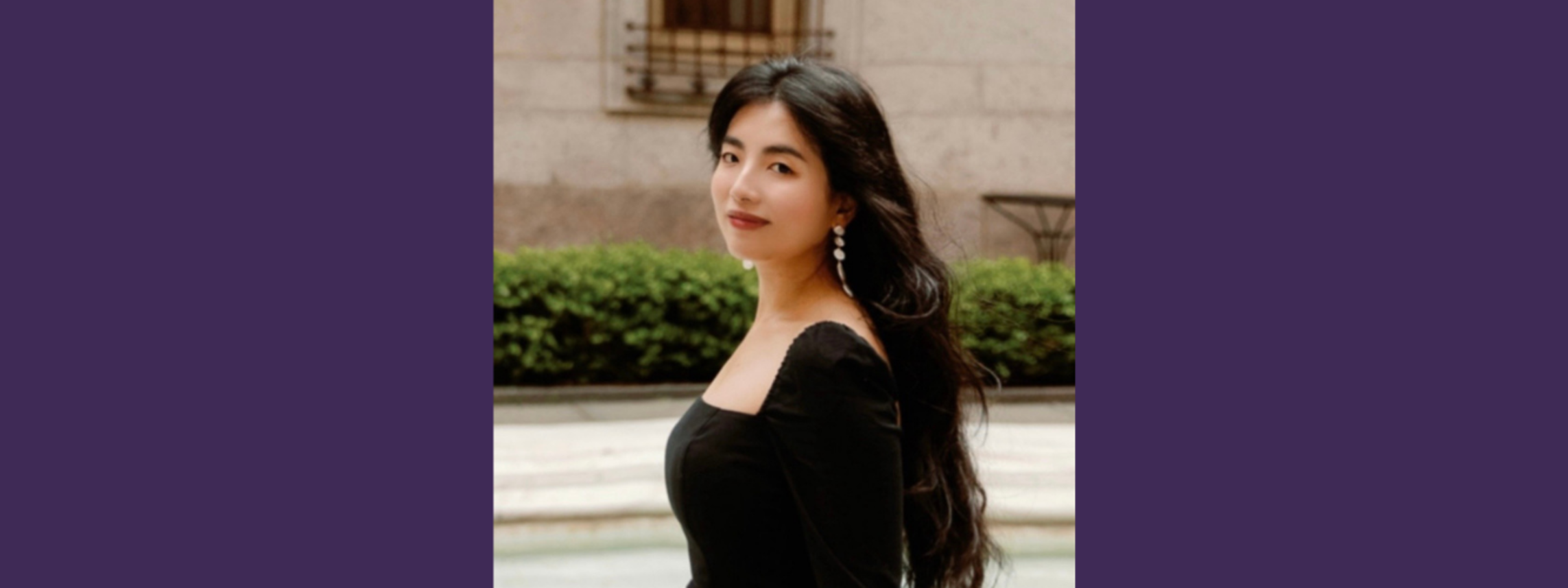
Alumni Spotlight: Rayna Chou ’15, ’17 MM
Rayna Yun Chou is a violist, award-winning interdisciplinary artist, and producer recognized by Boston ARTery as one of “25 Artists of Color Transforming the Cultural Landscape.” She has appeared at Carnegie Hall, Taiwan National Concert Hall, and venues across the United States. Her public art projects, including Concert for One (2019, Boston & Cambridge) and Hear the Light (2020, Taiwan), have been celebrated for creating intimate and transformative encounters with music.
Rayna holds degrees from NEC (B.M., M.M.), the Yale School of Music (M.M.A.), and Boston University (D.M.A.). She is currently a Producer at the Massachusetts Institute of Technology, where she supports the production and curation of residencies, programs, grants, and projects that connect art, science, and technology.
Why did you choose NEC?
I chose NEC to study with Professor Martha Katz, whose artistry I had long admired, and with professors whose teaching I came to deeply respect once I arrived. NEC also gave me the gift of Boston, a city I quickly fell in love with and where I have been living ever since. The richness of its history, culture, and arts scene became an essential part of my growth as both an artist and a person.
What have you been up to since graduating from NEC? What projects have you been working on? Do you have any goals you are looking to accomplish?
Since graduating from NEC, I’ve managed to earn a few more degrees, premiered a few public art installations, and even found myself onstage at Carnegie Hall. Somewhere along the way, I was named one of Boston ARTery’s “Artists of Color Transforming the Cultural Landscape,” a reminder that the spirit of curiosity and connection I first discovered at NEC has only continued to grow. And now, fittingly close to NEC yet just a river away, I work across the Charles at MIT, where exploration takes on new forms.
My first social experiment project, One Minute of Just Us (2016–17), was born directly from my NEC years. It challenged the usual distance between performer and audience, won the Entrepreneurial Musicianship Award, and quietly planted the seeds for the projects that would follow.
In 2019, I partnered with the Celebrity Series of Boston to bring Concert for One to Boston and Cambridge. With support from the City of Boston, Harvard University, and the Rose Kennedy Greenway, nearly 5,000 people had the chance to encounter music in its most distilled form: one listener and one musician at a time. The Boston Globe called it one of the year’s most groundbreaking public art events, though to me it felt more like thousands of small moments of magic strung together.
In 2020, I premiered Hear the Light in Taiwan, a site-specific installation of sound and light that invited audiences to immerse themselves in Mahler, darkness, and resonance. It was honored with the Mass Cultural Council Artist Fellowship in installation art and remains one of my most personal pieces, a reminder that even in uncertainty, art can hold both light and shadow.
Today, I serve as a producer at MIT’s Office of the Arts and MIT Center for Art, Science & Technology, where I produce residencies, lead student arts programs, and support projects that bring together art, science, and technology. My goal is to keep advocating for spaces where people can learn, collaborate, and imagine together, places where art can spark curiosity, open dialogue, and perhaps even a bit of wonder.
What are some of your favorite memories from your time at NEC?
Some of my dearest memories are of working with the Entrepreneurial Musicianship (EM) team. They believed in me before I fully believed in myself, and their support has remained constant long after graduation. I carry those lessons of encouragement with me.
I also remember so vividly the professors who left their mark on me: Professor Klein’s wit and brilliance, Professor Gallagher’s unforgettable piano lectures, Professor Exner’s attentive presence in history class, Professor Miljkovic’s seemingly limitless knowledge, Professor Truniger’s quiet grace in theory, and Professor Davidson’s inexhaustible stories. Studying viola with Dimitri Murrath ’08 AD and experiencing the artistry of the Borromeo Quartet were equally formative, giving me models of integrity and imagination in music-making. Studio classes and liberal arts courses alike made me feel that I was surrounded by minds and spirits who were inspiring, demanding, and endlessly generous.
Share a story about one of your favorite faculty or studio instructors.
Professor Lesser’s course, Aural Heritage of String Playing, remains one of the most transformative classes I've ever experienced. What set his teaching apart was not only the careful listening itself, but the way he wove first-hand stories into every session. He spoke about his time around musicians who helped shape the history of string playing with such vivid detail that we could almost imagine ourselves in the hall with him. He also shared lessons from his own teacher, Gregor Piatigorsky, whose artistry, humor, and humanity influenced an entire generation of musicians. Hearing these accounts from someone who had lived in such close proximity to legendary figures gave us the feeling of being linked to a much larger tradition, one in which our own voices also had a place.
In class, recordings were not treated as relics but as living windows into individuality. We listened to violinists, cellists, and viola masters of different eras, each voice carrying the weight of a lineage yet speaking with its own unmistakable accent. Professor Lesser taught us to listen for nuance, for personality, for the way interpretation is shaped by history, mentorship, and imagination. From viola legends who brought warmth and depth to the instrument, to cellists and violinists who carried forward the spirit of their teachers, the repertoire became a living family tree.
The final “needle drop” exam, where we identified players from only a few seconds of sound, crystallized this approach. They were not tests of memory, but invitations to practice a kind of deep listening that went beyond surface detail and into the essence of character. Professor Lesser reminded us often that the goal was not to imitate, but to recognize the courage and authenticity in others, and to find those same qualities in ourselves.
What I took away was more than a catalog of styles. It was the understanding that music is an unbroken thread of inheritance and invention, and that we are part of it. Professor Lesser gave us permission to embrace difference, to trust our own instincts, and to carry the lineage forward in our own voices. That sense of belonging to both history and possibility is something I carry with me every time I perform or create.
How have your NEC experiences shaped your artistic approach?
NEC was the beginning of everything for me. It was there that mentors and classmates gave me the courage to take risks, the freedom to explore, and the faith to pursue possibilities larger than I had ever allowed myself to imagine. Every step I have taken since leads back to my first days in Jordan Hall.
Share any other stories about what has inspired you at NEC and beyond.
At my graduation in 2017, a speaker said something that has never left me:
"I believe in all of you, and I know that each one of you has an incredible contribution to offer the world. If you come across the chance to make that contribution, go ahead and make it. There is always a way forward, even if it takes longer than you thought, or it takes place in a location you did not expect, with people you never imagined you would meet. If there is one thing you can expect after graduation, it is this: you will find you are stronger and more beautiful than you ever imagined you could be.”
Those words have been a compass for me ever since.
Do you have any advice for young musicians/current NEC students?
Do not be afraid to dream. As musicians, we spend so much of our lives in practice rooms, cultivating self-criticism as a tool for growth. Discipline is essential, and it teaches us persistence and precision, yet that same voice can sometimes make us fearful of possibilities and imperfections. To be both an artist and a human is to hold this duality: the rigor of discipline alongside the openness to dream. The world may tell you to be brutally realistic, but your dreams are worth pursuing. Whether it is winning an orchestra audition, daring to enter a competition, or choosing to reinvent yourself in another field, know that you have a community that believes in you.
Learn More About Rayna:
Current Job: Producer, MIT Office of the Arts / MIT Center for Art, Science & Technology
Major: Viola Performance
Degree: Bachelor of Music, Master of Music
Class Year: 2015, 2017
Instrument: Viola
Do you want to be featured in an Alumni Spotlight?