
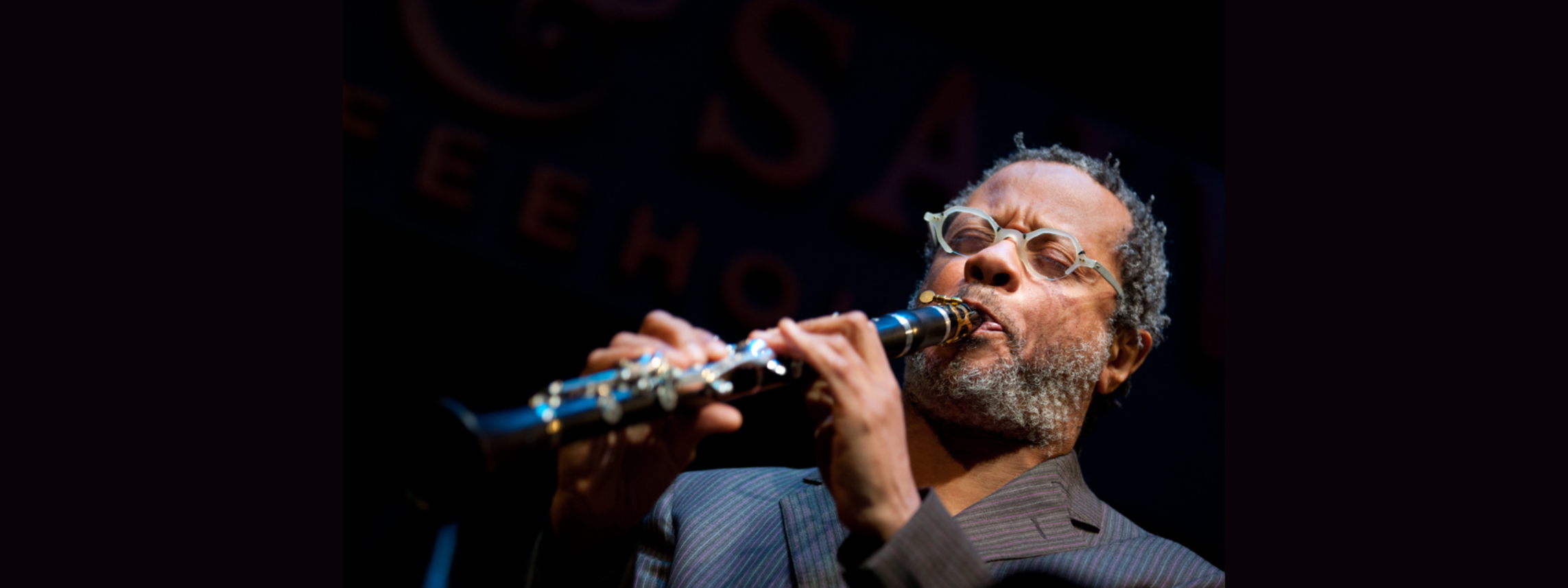
Alumni Spotlight: Don Byron ’84
As a clarinetist, saxophonist, composer, arranger, and social critic, Don Byron ’84 redefines every genre of music he plays, be it classical, salsa, hip-hop, funk, rhythm & blues, klezmer, or any jazz style, from swing and bop to cutting-edge downtown improvisation. Since being named "Jazz Artist of the Year" by Down Beat in 1992, Byron has been consistently voted best clarinetist by critics and readers alike in leading international music journals.
As a child, Byron developed asthma and his doctor suggested he take up a wind instrument as therapy – he chose the clarinet. Byron was encouraged by his parents to learn about all different styles of music, from Leonard Bernstein to Dizzy Gillespie.
Byron moved from Boston back to New York in the mid-80s, where he began playing with several of the city’s more prominent jazz avant-gardists, including David Murray, Craig Harris, and Hamiet Bluiett.
Don was also recently featured this month in the Boston Globe: “Musical adventurer Don Byron returns to NEC, where his explorations began.”
Join Don Byron, Ken Schaphorst, Hankus Netsky, and fellow alumni in Brown Hall for a
Jazz & CMA Concert Celebration on Thurs, Dec 8 at 6:30pm!
Click here to RSVP
Why did you choose NEC?
I chose NEC after I met Joe Allard while I was studying at Manhattan School of Music. I felt I was not receiving a good education there. One of my teachers even told me my lips were too big to play clarinet, and every semester my transcript would say saxophone instead of clarinet. Ironically, Manhattan was the only school where Joe wasn’t on the clarinet faculty, and once I experienced his teaching (on my own dime), I knew he was my teacher. Joe also knew enough about my life to know I could use some space from my parents. He suggested NEC and even pitched it to my dad.
Share a story about one of your favorite faculty or studio instructors.
Joe Allard was a unique man and promoted a lifestyle of woodwind excellence. He played clarinet and bass clarinet with Toscanini, was the dean of American saxophone, and taught Coltrane and Dolphy. He could listen to any music and break down how to play it. Among many things, he actually taught me how to count bars in a part without flipping out. He was the first college level teacher I had who was willing to teach me anything I wanted to know without any racial prejudice. He will never be equaled.
Studying with George Russell was the perfect complement to my studies with Joe Allard. It was exactly what I needed at the time. With Joe I played modern classical music that I played in ensembles, including Bartok, Stravinsky, Schoenberg, and Varese. George Russell gave me the tools to understand that music. I discovered that I played better when I understood what I was playing. George was really more of a theorist than a composition teacher, as the way he heard music was completely theoretical. Through him, I learned the Lydian Concept, which I found to be the perfect measuring tool for understanding Stravinsky (my favorite composer). Stravinsky and Mancini in particular were Lydian types, and over the years, I built my playing technique around the Lydian Scale. I don’t know how many of George’s students have also won the Rome Prize in Composition and been a Pulitzer finalist, but I owe it all to him.
Several people I played classical music with took John Heiss’ New Music class. In that class, Heiss preached that the basis of any New Music ensemble should be Pierrot Lunaire. As a result, I, along with my friends Patrick Jordan ’85 and the late Daniel Malkin ’88 rented the parts ourselves and independently produced performances of the piece on and off campus. We even played it at The Peasant Stock, a restaurant in Cambridge, while people ate dinner. I remember Heiss barging into one of our rehearsals, demanding to know who was allowing us to tackle the piece on our own (students generally hadn’t taken the piece on independently). After sitting through part of our rehearsal, he declared it passable. We were all very proud.
Share any other stories about what has inspired you at NEC and beyond.
As a child, Leonard Rosenman and Lalo Schifrin were the first composers I observed. My uncle loved film music and would recommend films for my mother and me to see just for the music. I was able to play and record with Lalo and I have stayed in contact with him ever since. He was as much of a Third Stream musician as anyone I have met, and told me that he had to hide his jazz activity to study composition with Messaien. He understood and connected to the range of topics I studied. I felt very affirmed by him, and I often attempt to channel his approach when I am scoring a film.
Mario Bauza was one of the greatest musicians I have ever worked with and one of the greatest lead trumpet players of all time. I heard him as a kid with Machito, and by the time I started playing with him, he was playing beautiful Marshall Royal styled alto. The man practically invented Latin Jazz by introducing Bird to Machito. He was deeply Afro Centric in a very sweet way, and as we got to know each other, it turned out he had studied clarinet too. We all adored him.
I played in the Ellington band under Mercer Ellington (we called him “Lefty”). As a black clarinet player, there weren’t many available gigs, but playing as one of the two clarinet chairs in the Ellington band was the pinnacle. We played on the original charts, not transcriptions. My parts to the Far East Suite simply said “Harry” on the top. That music is way further left than the way it is perceived, crazier, and from the inside, surprisingly dissonant. I daresay lots of people who pretend to love it don’t understand the constant risk taking involved in the writing.
In the late 80’s, very few young musicians were thinking about making their own music. I met Ralph Peterson when I subbed in David Murray’s Octet. He was a wonderful musician, and very interactive. We knew we could play together instantly, and after working together with Murray and Craig Harris, we started putting our own music together. Our group became known as Fo’tet and our first rehearsal took place in my parents’ basement. We made Black music that combined the Young Lions skill set with things we did in the Black Avant Garde and the Downtown Music I was involved in (I brought Ralph and Bill Frisell together). He was my naughty little brother. My favorite memory of him was when I hired him to play the percussion part in Stravinsky’s Ebony Concerto. No one will ever play the part better. My man!
Jack DeJohnette was one of my heroes, and it’s been my privilege to work with him. He is universally demanding. He also nudged me to pull some tenor sax together. I love the way he pulls high levels of straight aheadyness and Avante-gardiness together. Esthetically he is perfect. Always sounds modern, which is a big thing for me.
Learn more about Don:
Degree: Bachelor of Music
Major: Third Stream Studies
Instrument: Clarinet
Facebook: facebook.com/don.byron.3
LinkedIn: linkedin.com/in/don-byron-98942310/
Do you want to be featured in a NEC Alumni Spotlight?