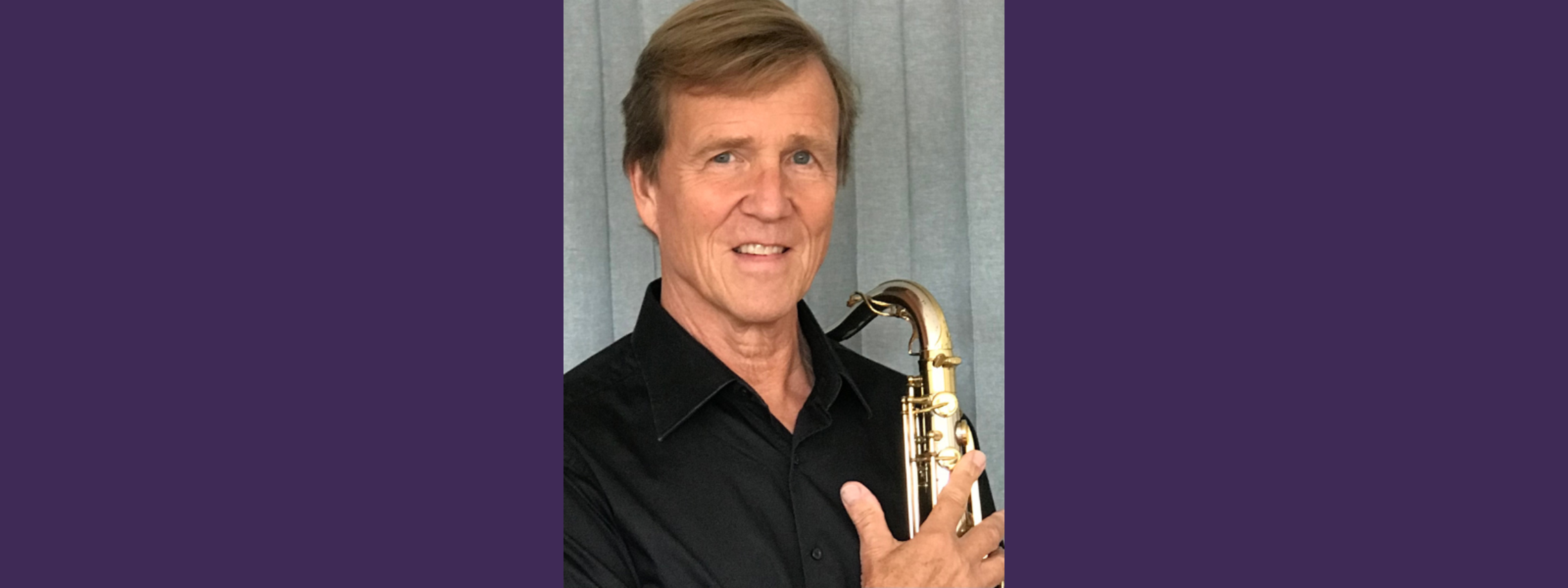
Alumni Spotlight: Oliver Griffith ’80 MM
Oliver Griffith ’80 MM has been playing professionally for over 50 years, starting his career in Boston, New England, and New York until 1985. He then went on to perform worldwide during his 20-year career as a US diplomat in Africa, South America, and Europe. After completing studies in Ethnomusicology and Jazz at Wesleyan University, he earned a Master of Music degree from the New England Conservatory. He also studied for two semesters at the Berklee School of Music and Classical Flute at the Richard Strauss Konservatorium in Munich. While working as a diplomat, he earned a diploma from France’s Ecole Nationale d’Administration.
Oliver has had a diverse musical career, playing with numerous bands in Boston, New York, and Washington, and globally in bands with artists such as Mary Wilson and the Supremes, Ted Curson, George Russell, Herb Geller, and South American pop star Franco de Vita. He has led jazz combos in Rwanda, the Central African Republic, Venezuela, Trinidad, Uruguay, Guatemala and France, appearing in dozens of clubs, concert halls, and cultural centers. Oliver’s groups have performed at festivals in Chad, Uruguay, and Trinidad, where he was a frequent guest soloist with the major steel drum bands. Alongside this, he has also performed on several radio and television broadcasts in the US and worldwide, and recorded four albums with musicians including steel pan player Rudy Smith, vibraphonist Dave Friedman, and guitarist Joe Cohn.
In 2007, Oliver retired from the State Department and moved to France to work as the Director General of the American Chamber of Commerce and later as Head of Communications for the International Finance Corporation (World Bank) for Europe. He started performing with some of France’s top musicians after his return. Since retiring in 2016, he has concentrated full-time on music, mostly playing classic jazz on saxophone and flute.
Why did you choose NEC?
I chose NEC because I knew it well, having grown up in Lexington and studying at Berklee. It had a great reputation for classical music and a Jazz Masters program staffed by some great players. Also, attending NEC would allow me to continue performing in New England and prepare me for a college teaching career. I was already aware that the market for professional jazz saxophonists was shrinking, so I thought college teaching would be a good way to support my musical endeavors. As it turned out, when I graduated in 1980, there were almost no teaching jobs available in higher education, so I decided to teach instrumental music in Boston and New York area schools.
What have you been up to since graduating from NEC? What projects have you been working on? Do you have any goals you are looking to accomplish?
After not being able to land a college teaching gig and being tired of the New England jazz circuit, I moved to New York to see if there was work for woodwind doublers on Broadway or elsewhere. Unfortunately, while there were more opportunities the competition was intense and the only gigs I landed were with Latin bands. I supported myself by teaching in private schools. After a couple of years, I decided to look for a new career, enrolling for an MBA at New York University and taking the test for the US Foreign Service. When I miraculously got into the State Department in May of 1985, I dropped music entirely and embarked on a 20-year career in Africa, Latin America and Europe. However, music came back to me and soon I was playing again. Since I was in countries with few established saxophonists, I began to earn better gigs than I did in the US. I continued working in non-music jobs until retirement in 2016, and since then have been fully focused on playing.
What are some of your favorite memories from your time at NEC?
Meeting and studying with many jazz legends such as George Russell '05 hon. DM, Jimmy Giuffre, Ernie Wilkins, and Jaki Byard was an honor. I also enjoyed being in close contact, in a chamber group and conducting class, with classical musicians, for whose talent and virtuosity I developed great respect.
Share a story about one of your favorite faculty or studio instructors.
I studied composition with William Thomas McKinley, who impressed me with his very cheery personality and his multifaceted talent as both a modern classical composer and jazz pianist. I recall seeing him play with Dexter Gordon on the latter's return to the US. His compositional style was daring as he would engrave the notes directly so they could not be changed. I disagreed with him on my favorite modern composer, George Crumb, whom he called too romantic, improvising some music on the spot that Crumb might have written.
How have your NEC experiences shaped your artistic approach?
During my time at NEC, each instructor had their own way of teaching, leaving it up to the student to develop their own artistic approach. Therefore, I don’t believe NEC changed my approach, but helped me to find my own voice.
Share any other stories about what has inspired you at NEC and beyond.
I have been most inspired by my contact with jazz musicians around the world while I was a diplomat. Wherever I went I could put together a jazz concert with standards with minimal rehearsal. Jazz has truly become a world music, and now everyone is playing the same chord changes from the iRealBook. (I remember buying the first Real Book near Berklee in 1973!)
Do you have any advice for young musicians/current NEC students?
I would caution jazz players, especially saxophonists, that the market for performing keeps shrinking, so it's good to have a second income source, preferably from music. Be open to exploring other career paths as you never know what you may end up enjoying!
Learn More About Oliver:
Current Job: Professional Musician
Major: Saxophone Performance
Degree: Master of Music
Class Year: 1980
Instrument: Saxophone, Flute
Oliver’s Book, “A Sense of Place – Journeys of a Musician Diplomat”
Do you want to be featured in an Alumni Spotlight?