
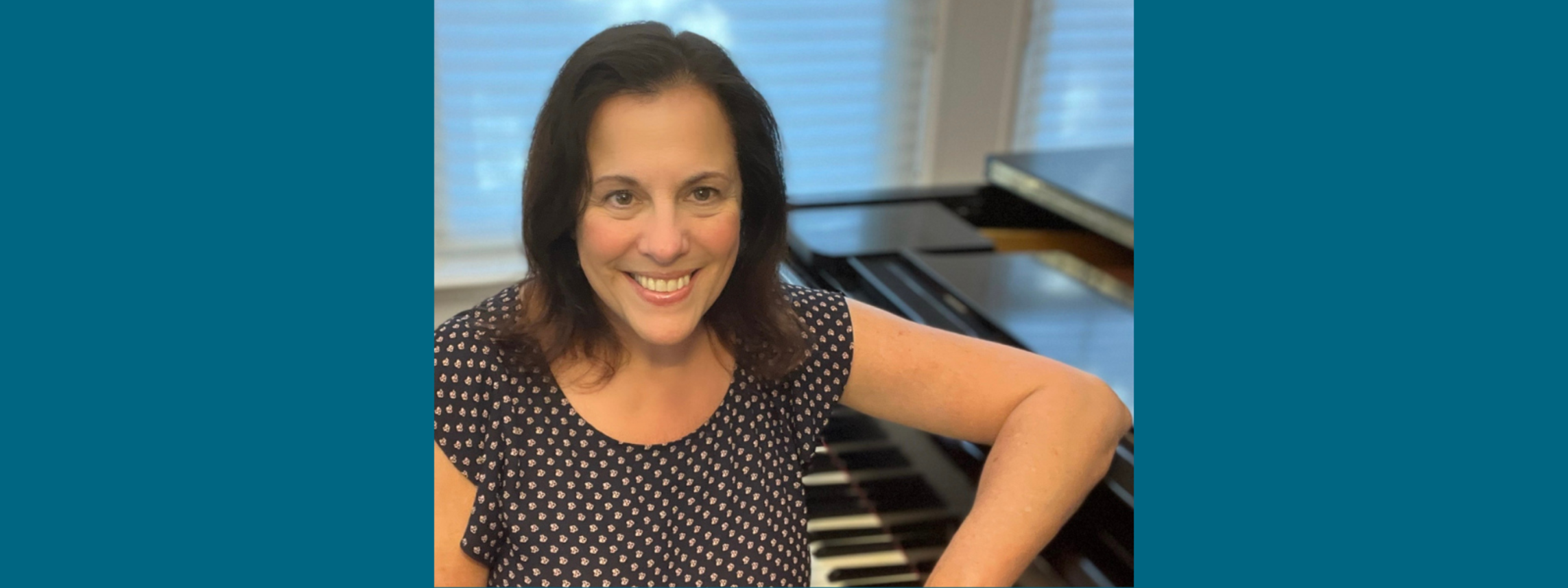
Alumni Spotlight: Terry Wolkowicz '86
For more than two decades, Terry Wolkowicz has been designing innovative and integrative arts curricula. As Education Director for the New Bedford Symphony Orchestra for the last fourteen years, Terry creates and performs educational programming in more than 50 schools across Massachusetts and Rhode Island. Most recently, she was appointed Chair of the League of American Orchestras’ Education and Community Engagement Leadership Committee.
In 2013, Terry was named New Bedford Woman of the Year for her contributions to the community, and in 2014 she was selected as a Myra Kraft Community MVP Award winner by the New England Patriots Foundation. In 2016, the Learning in Concert program she developed received the Excellence in Education Award from the Goldin Foundation and the Massachusetts Secretary's Award for Excellence in Energy and Environmental Education.
Terry received her Bachelor of Music in Music Education from New England Conservatory and a Master’s Degree in Education from Harvard University.
Why did you choose NEC?
When I was studying piano at the Settlement Music School in Philadelphia, my instructor suggested I go to NEC due to its reputable music training. My instructor helped me prepare for my auditions, and I was accepted.
What have you been up to since graduating from NEC? What projects have you been working on? Do you have any goals you are looking to accomplish?
For the last 14 years, I have been the Education Director of the New Bedford Symphony Orchestra (NBSO) where I created the Learning in Concert program. This yearly, three-phase program educates over 50 schools across the South Coast of Massachusetts on the related concepts between music and science. These concepts include gravity in musical tonality and chord cycles, and balance in orchestration. NBSO also offers an after school pre-k music and literacy program to New Bedford Public Schools called the Fanfare Project. The Fanfare Project allows students to select someone special to them and create a fanfare designed for that person. An NBSO trumpeter then performs the fanfare and the students read their dedications aloud at their final event.
I also co-founded a nonprofit organization called Sound Explorations with Dr. David MacKenzie in 2021. Sound Explorations has partnered with prestigious agencies, including the National Oceanic and Atmospheric Administration, to communicate marine science through music. In our Whales in Motion project, blind and visually-impaired adults and children interact with specially-designed sculptures demonstrating Humpback and North Atlantic right whale foraging, swimming, and diving behaviors. As the participant’s hand traverses the sculpture, a musician performs live, playing music that mimics the exact speed, contour, and motions as perceived by the participant’s hand. This program has been provided to the Lowell Association for the Blind, the Perkins School for the Blind, the Carroll Center for the Blind, and various adult low vision support groups. To celebrate Right Whale Day on April 24th, the Whales in Motion experience will be available at the Museum of Science in Boston for a special one-day exhibit.
What are some of your favorite memories from your time at NEC?
A favorite memory I have was communicating with other students by sticking notes on the Beethoven statue. I also found my Doctoral Music Theory seminar with Robert Cogan to be such an interesting class. I appreciated how he allowed us to pick a topic unrelated to music and deeply explore and share it with other students. Professor Cogan instilled in his students the importance of curiosity and encouraged them to always learn something new.
Share a story about one of your favorite faculty or studio instructors.
My favorite faculty member was Lyle Davidson ’62, ’64 MM, who was my professor for ear training. He once assigned us to read an article on Jean Piaget and create an outline on it. The purpose was to better understand the process in which we learn, but I was initially confused why we were doing this. Now as I reflect, it was a pivotal moment that began my interest in music learning and cognition, and I came to realize it is possible to learn about human development while sight singing through the dreaded Dannhauser.
How have your NEC experiences shaped your artistic approach?
In that same Music Theory seminar with Professor Cogan, we were asked to use graphic notation to analyze music. Although we could all read music, this process allowed patterns to appear more prominently on the page and I have continued to use this method throughout my career. I teach graphic notation to children to remove the barriers of prior music knowledge and help them assume the true role of a composer.
Share any other stories about what has inspired you at NEC and beyond.
I have been fortunate to learn from NEC professors Lyle Davidson ’62, ’64 MM, Larry Scripp, and Josh Gilbert. They influenced my professional career in so many ways, and I continue to use the knowledge I gleaned from their teachings as a foundation for the programs I previously and currently design. For example, The Learning in Concert program branched from Larry Scripp’s "Learning through Music'' program – it was where I discovered the importance of multiple representations and learning by making connections across different contexts.
Do you have any advice for young musicians/current NEC students?
Stay flexible and understand that you may experience many pivots in your career. As a result, you may end up in an unexpected position that you thoroughly enjoy.
Learn More About Terry:
Current Job: Education Director at New Bedford Symphony Orchestra; Co-Founder of Sound Explorations
Major: Music Education
Degree: Bachelor of Music
Class Year: 1986
Instrument: Piano
Website: http://www.nbsymphony.org; www.soundexplorations.org
Facebook: https://www.facebook.com/terry.wolkowicz
Instagram: https://www.instagram.com/twolkowicz/
LinkedIn: https://www.linkedin.com/in/terry-wolkowicz-09008b79/
Do you want to be featured in an Alumni Spotlight?